

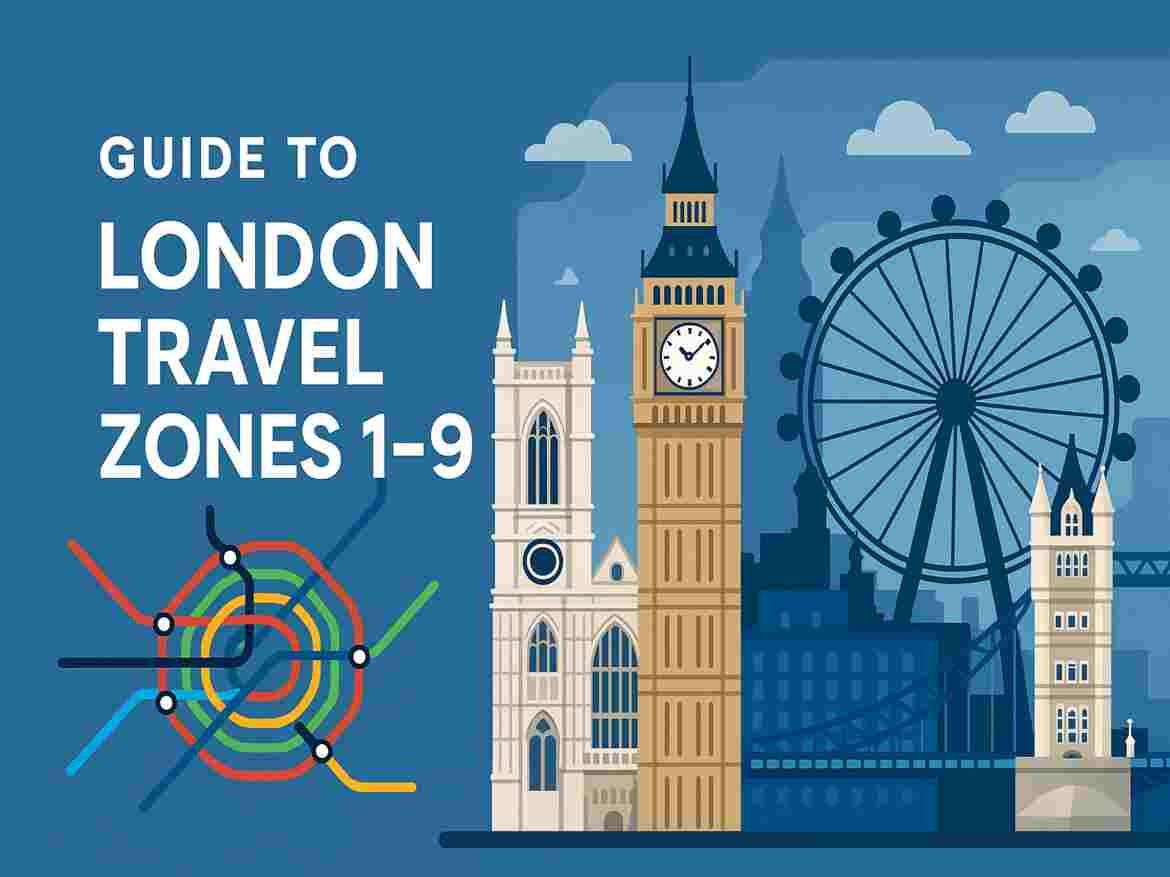
Are you planning to study in London, United Kingdom but the London zones confuse you the most? When in London you will definitely hear about the various London Travel zones, the city has and how it helps travellers and explorers in defining the transportation cost and discount costs. Once you know about the zones in London, commuting becomes more easy and less confusing. This guide breaks London into the 9 zones it has which will make you confident to explore the city like a local.
Understanding the London Travel Zones
Every city is governed by its own transport system and it is as simple as that. The London public transport system is divided into nine travel zones and is arranged as outward concentric circles. The zone 1 is the central region of the city and the other zones extend outward of it. It is just like the bullseye with each zone forming outward circles. The zone numbers therefore increases as you move outward towards the suburban regions of London and along its countryside.
London zones 1-9 define the public transportation costs, the ticket fares and travel passes needed and also determine what is covered in your Oyster card, travel card and other contactless card.
One important thing to note here is that the farther you move across zones the more it will cost you to explore the city across zones.
Zone 1 is Central London
Zone 1 is the central part of London which includes most the cities iconic locations and landmarks like:
- Westminster
- Soho & West End
- Covent Garden
- Mayfair
- City of London (The Square Mile)
- South Bank
- Bloomsbury & Holborn
- Kensington & Chelsea
- Camden
The zone 1 has regions ideal for sightseeing, official meetings, or if you are likely visiting museums.
Zone 2: Inner London
The next Zone that surrounds London Zones 1-9 covers the most popular residential and cultural area of London namely:
- Shoreditch/Bethnal Green
- Brixton
- Clapham
- Notting Hill/Holland Park
- Islington
- Maida Vale
It is worth noting that many locals prefer this to live in this Zone mainly because it offers lower cost of living and also good accessibility options.
Zone 3: Outer Inner London
London Travelcard Zone 3: This zone corresponds to locations such as
- Ealing
- Newham
- Haringey
- Islington
- Wandsworth
- Lewisham
- Waltham Forest
- Parts of Richmond,
- Tower Hamlets
- Barnet and Hackney
Residential areas like Stratford forms a part of the London Zone 3 and is a favourite among commuters who want more space without spending hours on public transport.
Zone 4: Greater London Suburbs
London’s Zone 4 covers outer London areas like Richmond, Wembley, Ealing, Hounslow, Barnet, Bromley, Croydon, and Enfield, offering a mix of suburban living with access to parks (Richmond Park) and attractions (RAF Museum, Wembley Stadium), balancing space with city connectivity.
Zone 4 includes the following areas
- Richmond Park
- Wembley Stadium & RAF Museum
- Royal Botanic Gardens, Kew
Zone 4 of London Zones 1-9, provides more relaxed, quieter neighbourhoods compared to central London, with good transport links via tube, Overground, and DLR (e.g., Woolwich Arsenal).
Zone 5: Further Residential Areas
The Zone 5 of the London Zones cover the suburban neighbourhoods and is popular as a residential area which is far more affordable than the other London Zones. Homes are generally more affordable, and you’ll find plenty of open space.
- Bromley
- Croydon
- Kingston upon Thames
- Twickenham
Zone 6: The Boundary of London
This zone is considered the out part of London and is home to notable places like:
- Croydon
- Heathrow Airport
- Uxbridge
This area is home to major transport hubs and is known for long distance community and airport travel.
Zones 7–9: Going Farther -Greater London
The Zones 7, 8, and 9 extend beyond what most people consider “London proper.” These zones mainly cover:
- Small towns
- Semi-rural areas
- Long-distance commuter routes
Most tourists will never need to travel beyond Zone 6, but Zones 7–9 are useful for people who live outside London and commute in daily.
How Tickets and Payments Work Across Zones
As mentioned earlier the public transport system of London work across it various zones and the system is majorly accessible by the following:
- Oyster cards
- Contactless cards that mainly include debit or credit cards
- Travel cards
The system works according to the London zones and the fares of the public transportation system is also calculated as per the zone you are in.One good thing about this system is that there is daily and weekly capping of the prices so that no one pays after a maximum of the amount ser for travelling across zones.
To sum it up we can say that the London zones may seem to bewilder the mind but it is important to understand the zones first and then decide for your stay in any of the London zones. Once you understand the zones, planning your commute will get far more easier and will help you save money and much of your valuable time.
FAQs
1. Is there a need to know all nine zones?
No. Generally, a visitor would only travel through zones 1-3, and occasionally zones 4 and 6 for airports.
2. Is zone 1 the costliest zone for travel?
Yes. Trips in and through zone 1 tend to cost more than those in and within the outer zones.
3. Can I travel between zones with a single ticket?
Yes you can travel. You can travel through Oyster card and contactless payment across zones.
4. Which zone includes the Heathrow Airport?
Heathrow Airport is in Zone 6 for London.
5. Are the buses zoned?
No. London buses have a unified fares system, irrespective of the zones.
6. Are the outer zones better value for money?
In general, yes. It becomes less expensive to live in areas that are far from Zone 1.
7. Do Travel cards include all zones?
It depends on your travel area and the zone you are in.
8. What if I travel outside my paid zones?
You might have to pay additionally or face a fine if you have the wrong ticket.
9. Is contactless payment better than buying a ticket?
Generally, yes. It is the most convenient, economical and faster way to getting your tickets.



Join The Discussion